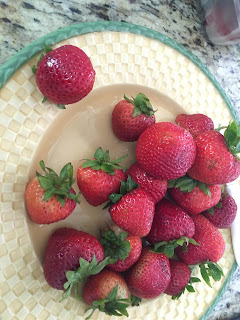
As it is June, strawberry season is in full swing! A great activity for toddlers, strawberry picking gets everyone outside and allows children to taste the fruits of their labor. 

If you are looking for new ways to use up the extra berries, try making freezer jam.  Kids have fun mashing up the berries and it is not as time consuming or complicated as regular jam-making. I used this recipe.

Enjoy!


Has your infant outgrown newborn diapers before you were able to use them all up? Don’t throw them away!  Try these ideas instead:

1. Use them as ice packs. While recovering from my c-section, the nurses in the hospital would occasionally give me ice packs for my sore stomach. To my surprise, these packs consisted of ice shoved into an opening in a newborn diaper. As the ice melted it was absorbed into the diaper and did not leak at all. Genius! I will use this in the future for boo boos (maybe even a headache or two). 


2. Use them to water your container plants. I haven't tried this yet, but the internet is filled with videos about using diapers to water your plants.  Take a look!  I know that I will try this on our house plants when vacation time rolls around. 


3. Use them to mop the floor. I tried this today and I must say that I was pleasantly surprised.  


Place a diaper on the bottom of a Swiffer-type floor mop (any mop with velcro on the bottom will do the trick).  I use this natural floor cleaner.  Simply spray your cleaner of choice on the wood floor and go to town! 


4. Use them for packing up fragile items. Diapers are soft enough for a baby's bottom, so why not use them to pack up delicate vases?    


If you have found an alternative use for extra diapers, please share in the comments!  


I have not been crazy about every class I've tried with my son, but I must say that this class is a complete winner!  Kindermusik offers a wonderful balance between creativity, movement (which is so needed during the toddler stage), and literacy.

This is a blurb from Jen's Kindermusik website:
"With more than 35 years of experience as the leader in musical learning, Kindermusik International understands music’s unique ability to impact children (and families!) in profound ways.  Across private studios, public schools, and childcare centers in over 70 countries, children, parents, and teachers enjoy participating in Kindermusik’s fun, developmentally specific, and research-based music and movement classes. Parents also appreciate how enrollment in Kindermusik includes home materials, including their favorite songs, stories, and learning activities from class, so families can 'play' Kindermusik wherever they go."

As you've probably determined from the above quote, Kindermusik is an international franchise.  I cannot speak for every Kindermusik class out there, but I can attest to the fact that this particular class, Kindermusik with Jen (in West Hartford), is wonderful! Jen has a very warm way with children.  She is understanding when your child just wants to run around the room like a maniac. She is also extremely encouraging. These are just a few of the reasons why we have continued to take this class.  

Each session of Kindermusic has a theme.  This past session, the theme was all about the outdoors. The songs for this session were great.  During each class, Jen also shows pictures of different animals or objects (according to theme) and plays the sounds that each one makes.  This really helps children make connections with the world around them on a different level. My son particularly loved the bird sounds. After seeing the pictures and hearing the bird sounds, be became kind of obsessed with birds.  We now have a few bird books and he will spot every bird along the way when we take walks.   

Each session,  you will receive a book, a CD with all of the songs sung in class (and more!), as well as an instrument. My son has a growing collection of Kindermusik books and instruments, which he loves. 

Whether it is dancing with scarves, shaking maracas, tapping drums, or playing with the giant parachute (a class favorite), your child is bound to love the movement this class offers.  

If your child loves music and movement, this is certainly a class worth looking into.  There are classes for many different age groups, so feel free to ask about the right fit for your own child. 

A free trial class in usually offered before the start of each session.  For more information, visit www.kmwithjen.kindermusik.com.  You can also contact Jen Ludgin at jenludgin@comcast.net to schedule your free preview class. 


Tinkergarten: A Class for Creative Outdoor Play


Last week I brought my son to a Tinkergarten free trial class. The location was a bit of a drive for us, but I was curious about a class that focuses on outdoor play and using nature to boost a child's empathy, problem solving, and creativity. 

Before the start of the class, I received an email telling what to wear (clothes you don't mind getting dirty and rain boots) and to bring a snack. I popped my son in said style of outfit and we headed out. 

The class was in a state park, which provided a beautiful backdrop. When we arrived, the other students were assembled by the teacher at the center of an open field by the side of a little lake. A red covered bridge crossed a stream that ran a few yards from the lake. It really couldn't have been more picturesque. 

The teacher greeted us as we approached and handed me a little metal bucket for my son.  She said that our job was to wander around the area and to collect "nature treasures."  We ambled around the field and onto the tiny beach by the lake while picking up stones, sticks, and yellow dandelions. 

After a while, the teacher called everyone back to her.  She had all of the kids sit on a tarp while she read Stone Soup (one of my childhood favorites). Next, she pulled out a big cooking pot and announced that they would be making stone soup.  She informed the children that they would need to use their imaginations as they again took their pails and searched the area for "ingredients" for their own soup.  Pine cones were carrots, sticks were celery, and, of course, stones came into play. 

After collecting all of the ingredients, the children, parents, and teacher headed back to the big pot. They added their ingredients one at a time.  A few kids went to get water from the lake to add to the "soup." The students took turns mixing the soup.  At the end of class, everyone had a snack brought from home. 

All in all, it was very cute and everyone seemed to really enjoy the activity. 

I have to say that my son did enjoy collecting sticks and putting his hands in the sand and dirt, but I do think he was a little too young for this class.  

I'm glad we went to the trial class because now I know that I would sign him up in a year or two, but also that I wouldn't spend the money on it at his current age (He's nineteen months old and we can collect sticks and rocks at the park for free). The class is marketed for children 18 months to five-years-old, however, the kids who were a bit older seemed to get much more out of it.  I would recommend this class for children ages 3-5.  
It is pouring today, which has me thinking of the old saying: April showers bring May flowers.  If this is true, we should have a ton of flowers come May.

I love flowers and gardening, and I just can't wait to get started.  If you're like me, your green thumb is raring to go.  If you are not into gardening, but want to give it a try, here are some important things to consider:

* Most of Connecticut is located in Zone 6 (6a and 6b).  This means that our last frost usually happens around May 1st. You can start planting certain veggies (like snap peas) in May.

* Find a nice, sunny patch of land for your garden. 

* If you don't have a sunny patch, worry not.  There are plenty of veggies that can tolerate partial shade, like spinach and kale. Click here for a list of said vegetables. 

* Start small.  You don't need a huge garden to begin.  If your garden is successful this year, go bigger next Spring. 

* Plant vegetables that you will not get sick of.  Last year, I went crazy planting string beans and by the end of the summer I was pretty tired of them.  The tomatoes, on the other hand, were great to have all summer long. 

There are many benefits to gardening with children.  Gardening can encourage children to eat vegetables, as they are proud of what they've grown and eager to try it. Gardening can even relieve stress and provide and outlet for your child. 

Whether doing a container garden in pots, or sectioning off a portion of your yard, get your hands in the dirt and see what you can make grow! 


You may be saying, "Cord blood banking? Wha?"

My husband and I had never even heard of cord blood banking until a few years ago, when one of my husband's cousins had mentioned it after the birth of her twins.  Even now, I only know a handful of couples who have opted to save their baby's cord blood.

The idea of cord blood banking was very appealing to me from the get-go.  The cells saved when cord blood is stored could potentially save your child's life later on.  Hopefully you'll never need to use it, but it is nice to know that it is there.

According to Viacord, the stem cells collected for cord blood banking can help to treat a number of ills. Current stem cell uses range from treating various types of cancer to blood disorders, to metabolic disorders, to immunodeficiencies. If your child needs a stem cell treatment, you will already have a 100% match.  If a sibling of that child is in need of a similar treatment, that child will have a 75% chance of a match (using a siblings cord blood cells).

Here are a few things to consider when dealing with cord blood banking:

Public vs. Private Banking
After deciding whether or not to store your baby's cord blood, it is important to consider what sort of banking you'll use. This could be the subject of an article on its own, but here's a quick summary of each:

If you choose public banking, you are donating your child's cells for public use.  If your baby's cells are a match for a sick child, they can use those cells, and visa versa.

If you decide to go with private banking, your child's cells are only used for your family.  You will always have access to those cells, so long as you continue to pay the storage fee.

Cost
This is the rough part!  Cord blood banking is very pricy.  There is an initial collection and storage fee, usually followed by an annual fee to maintain the storage of cells.

The Process of Collecting the Blood
You receive your kit just prior to your due date.  You will bring this with you to the hospital. Immediately after the birth of your child, the umbilical cord is clamped and the cord blood is removed via syringe.  It is a painless and quick procedure, for both mama and baby. The doctor packs everything into a little cooler and a number is called for pick-up (Your kit is picked up that day). Easy Peasy!

What if you are having a c-section?
It is still possible to store your child's cord blood.  It is also perfectly safe. Click here for more information on collecting cord blood during a c-section.

Want to learn more? 
Visit the following links below to learn more. It's a great idea to discuss this with your OBGYN and pediatrician, too.  See what they have to say about it.

Most importantly, trust your gut.


Resources

This is a step-by-step guide to cord blood banking from What to Expect.

Cryo-cell also provides information on banking cord tissue.


It's a rainy day and I am craving something hearty and warm for dinner.  The only problem is that I have no desire to cook.  I usually make dinner when my son is napping, but I don't always want to spend that whole time cooking.  I need some me time too.

My solution to this problem is lentil soup.  It is hearty and delicious.  The bonus is that it literally takes 15 minutes (probably less) to make.


I use low sodium chicken broth, frozen lentils, pre-chopped mirepoix (onions, carrots, and celery), half a ham steak, olive oil, and Mural of Flavor (a spice mix from Penzeys).  

I basically dump all of the ingredients into a soup pot and let it simmer until dinner time, leaving me ample time to write, read, or take a cat nap.  Purrfect! 

Ingredients

32 oz. low sodium chicken broth
16 oz. bag frozen lentils
1 container of pre-chopped mirepoix
half a ham speak, chopped into half-inch cubes
olive oil
3 shakes of Mural of Flavor spice mix (you can use your favorite spice mix)

Add some oil to a soup pot on medium heat.  Dump the mirepoix and spice mix into the pot and give that a little stir. Add the lentils, followed by the broth. After the soup starts bubbling, reduce the heat to medium low and cover.*  Simmer until your ready to eat.  

I usually serve this with a slice of havarti cheese mixed in.  I sprinkle the top with crackers.  It is so good! 

 Enjoy!


*You can also put the heat on low and just let it slowly cook for hours.  This is a no stress approach to awesome soup.